Showing posts with label book. Show all posts

Monday, April 30, 2012

ArchInspire #027: Vault Patterns


Here's a repost from Visual News -
The next time you find yourself in a Romanesque or Gothic European church, cathedral or basilica, lay down on the floor and cast your eyes up to the mesmerizing ceiling. Built between the 12th and 16th centuries, it’s hard to believe the level of detail and variation in these marvels of architecture from over half a millennia ago. The designs, full of intricately repeating ribbed diamonds and triangles, look like kaleidoscopic designs carved from stone… actually, that’s not far from the truth.

In his book Heavenly Vaults, photographer David Stephenson continues his work he began with his book Visions of Heaven, taking images of the ancient houses of worship that fill the european continent. The book captures many ceilings of the transcendent structures, designed in a time when they easily towered over any surrounding buildings, with the intention of inspiring passerby to higher callings. Stephenson’s images flatten the vaulted ceilings, simplifying them to their essential shapes and emphasizing their repeating patterns, intricately carved detailing and colorfully painted ornaments.

The beautiful book contains 104 pages of photographs and an accompanying essay by Stephenson charting the history of the vault and explaining its technological developments. You can see more images from his series here.


Sunday, March 4, 2012

Book Feature: The Confessions of St. Augustine


"It could be said that all roads of Christian Latin literature lead to [Augustine]," 
+Pope Benedict XVI

Here's a book I've been clamoring to have since I first read of it in our Introduction to Philosophy subject course - The Confessions of Saint Augustine! Under the topic of medieval philosophy, I was actually reading back then another translation of one of his most important output The City of God, which is a general apologetic writing that answers to the pagans of his time. A leisurely-spent hour at Powerbooks - Gateway led me to find this treasure :) Very insightful indeed, reading this modern translation felt like snooping at someone else's diary - and not just any ordinary diary, but that of a holy man's struggle and journey to sanctity. Below is a brief which can be found at the backflap of the book:

Signet Classics
The Confessions of Saint Augustine: 
The Classic Autobiography of the Man who Journeyed from Sin to Sainthood
A vivid contemporary translation by Rex Warner
"Every vain hope," recounts Saint Augustine of his introduction to philosophy, "became empty to me, and I longed for the immortality of wisdom." With the emergence of his Confessions more than fifteen hundred years ago, immortality would soon be his. "All of antiquity's philosophy converges in his work," noted Pope Paul VI. 
Hailed by Pope Benedict XVI as "the greatest Father of the Latin Church... a man of passion and faith, of high intelligence and untiring pastoral zeal," Augustine tells the story of his remarkable life. From his days of devil-may-care debauchery to saintliness, from traveling the ancient world to taking the vows of an ascetic life, his gripping biography intertwines with his insights of endless wisdom.
Rex Warner, who was born in England and studied at Oxford, established an international reputation with his translations, which include Three Great Plays of Euripides, The Greek Philosophers and Thucydides's The Persian Wars.
For more of St. Augustine's life and works, click here and here.

Wednesday, February 1, 2012

Book Review: The Eight Beatitudes by George Chevrot


The Eight Beatitudes - Reflections on the Sermon on the Mount is a title by George Chevrot originally in French (Les Beatitudes) republished here in the Philippines by Sinagtala. Ranking at Top 1 on my best reads, the book is an exposition on the blessings (beatitudines, benedictiones) that mark the opening of the Sermon on the Mount, the very first of Our Lord's sermons in the Gospel of St. Matthew (5:3-10) and of St. Luke (6:22). The book is a great material and resource for meditating and reflecting on the Beatitudes which was also described to be the very self-portrait of Jesus. With a few chapters of introduction to set the context of the exposition, the reader will find himself going over each of the beatitudes in full detail of textual meaning and criticisms.
The name beatitudes ought not to mislead. They are less a promise of happiness than the assurance of God's blessings; and the eulogy they contain cloaks a commandment, the imperative character of which is softened by God's favourable regard to those who obey it.
This is indeed the case with the Beatitudes which open the Sermon on the Mount. The listeners were impatient to know Jesus' messianic programme; the Master was therefore going to promulgate the laws of the kingdom. But instead of enumerating them in the manner of the precepts of the Decalogue, he praised those who observe them, he called on the 'blessed', the fortunate in whom God would reign and on whom he was counting to establish his kingdom on earth.
Later Jesus would enumerate his disciples' duties in detail, but before prescribing what they ought to do,  he declared what they ought to be. The beatitudes describe what would be the characteristics of Christ's disciples. If they had the qualities described by Jesus, they would be whole men and the agents of a better world.
Man's dignity is not to be measured by earthly standards. In making him bring his earthly task to perfection, Christ is helping him reach that greatness which goes beyond the human condition.

Bearing the name of the religious congregation on which became the center of my vocational discernment this past few months, the book has been a big help for me :) And true enough, as missionaries or followers of Christ, instead of asking the Lord on what we must do and what we must have to be his faithful disciple, we must seek first and ask on what we must be - and he will gladly reveal to us the teaching of being, especially of the teaching of that being led.

Tuesday, January 24, 2012

Book Review: YOUCAT


After the Bible, here's a book which is a staple content of my backpack lately, a bedside book, as well as something I regularly bring with me at the Adoration Chapel. YOUCAT is short for Youth Catechism of the Catholic Church, which is the official catechism for World Youth Day. True enough though the questions are direct and honest, even at times tough; the answers are straightforward, relevant, and compelling - a sure "go-to" place for young people to learn the truth about the Catholic faith. 

It explains: What Catholics believe and why (doctrine), How Catholics celebrate the mysteries of the faith (sacraments), How Catholics are to live (moral life), How they should pray (prayer and spirituality)
The Youth Catechism which is written in language suitable for young people, deals with the entire Catholic faith as it was presented in the Catechism of the Catholic Church (CCC of 1997), without aiming, however, at the completeness provided in that volume. The work is structured in Question-and-Answer  format, and  numbers after each answer refer the reader to the more extensive and in-depth treatments in the CCC. A  commentary  following the answer is meant to give the young person  additional help in understanding the questions that are discussed and their significance in his life. Furthermore, the Youth Catechism offers in the margin a continuous series of supplementary elements, such as pictures, summary definitions, citations from Sacred Scripture, quotations from saints and reliable teachers of the faith but also from non-religious authors. At the conclusion of the book, there's an index of subjects and persons to facilitate finding specific topics.
Plus factors: Pope Benedict XVI wrote the foreword; Cardinal Christoph Schoenborn, the editor of YOUCAT and the Archbishop of Vienna, Austria, wrote the afterword. All pages are in glossy print. Appealing graphics: try flipping the bottom-right edge of the pages to see what the cartoon stick figure does :)

What Pope Benedict XVI has to say about the YOUCAT project:
"May people say to me: The youth of today are not interested in this. I disagree, and I am certain that I am right. The youth of today are not as superficial as some think. They want to know whatlife is really all about. A detective story is exciting because it draws us into the destiny of other men, a destiny that could be ours. This book is exciting because it speaks of our own destiny and so deeply engages everyone of us."
"Study this Catechism! This is my hearlfelt desire. Study this Catechism with passion and perseverance. Study it in the quiet of your room; read it with a friend; form study groups and networks; share with each other on the Internet... You need to be more deeply rooted in the faith than the generation of our parents..."
For more information check their official website here. Check out the book trailer below:


Tuesday, December 27, 2011

Book Review: Manga Messiah Series


If your cup of tea is manga and Christianity then here's something interesting for you - new book installments of the Manga Messiah series by NEXTmanga available for only P215 @ Fully Booked. Though nothing beats like reading the original and complete passages of the Word of God from the Bible, I think it is truly genius to use the art and media of Manga (Japanese comics) to reach out to the younger generation whom are saturated nowadays with the flood of interests and modern ideologies. 

'The youth of today are not as superficial as some think. 
They want to know what life is really about.'
Pope Benedict XVI, foreword of the YOUCAT

I bought my first copy of Manga Messiah from a friend's recommendation years ago - back in my pre-teen years where anime and Japanese pop art and culture dominated my interests. It came in perfect timing as I remember it was also about that time when I started to feel the thirst to know and understand life better from all that I believe and the truths that I adhere to as a Christian. The idea of studying the Gospels then from a comic-type of perspective was a bit unconventional but cool in my young mind. The series truly is a plus for young beginners :) 

So here's my review: 

What I have always loved about the series of Manga Messiah is its strict adherence with the Scriptures from where it was based and the consistent format from its first installment. At the bottom of each page where a scene takes place is a footnote of the verse from which one can cross-read the Bible to see the exact seen from where it was lifted. 

  • [A] Manga Messiah, which is the first installment of the series was written by Hidenori Kumai and was illustrated by manga artist, Kozumi Shinozawa. It covers the consummated version of Yeshuah's earthly ministry in the Four Gospels of the New Testament, starting with the Anunciation of Yeshuah's birth to Mary and ending in his Ascension in Heaven. 
  • [B] Manga Mutiny, which was written and illustrated by manga artist Ryo Azumi, covered the Books of Genesis and Exodus from the Old Testament. The flow of the story in this work was quite fast but it nevertheless successfully painted the important events and stories of God's covenant in the history and nation of Israel. A brief family tree which is of great reference is also illustrated at the end of the book - starting with Adam and Eve, going thru the generations of Abraham, Isaac, Jacob and Joseph.  
  • [C] Manga Metamorphosis, which I have yet to read was also written and illustrated by Kozumi Shinozawa. Covering the entire Book of the Acts of the Apostles, it starts from where Manga Messiah ended. Peter the Rock and Paul the Aposlte, together with other followers of Yehsuah's ministry, was the main character in this installment. 

For more information of the Manga Messiah series, visit NEXTmanga.

Wednesday, December 14, 2011

The Little Prince - Vice and Virtue

The Baobab Tree (Image borrowed here)
Just finished reading the classic novella by Antoine de Saint-Exupery, The Little Prince. I've read it twice in high school but it is only now that I've truly understood the meaning of some of the words of the author. What astounded me is the great connection and reference the novella had with our 'inner child' and the importance of having to look at life with a childlike perspective even as a grown adult - something that I would have never realized if it wasn't for the prayers of a particular person I met a couple of months ago :) 

The novella truly is brimmed with parallelisms (well, at least for me) and I'll start off with one of the most remarkable words I found on the first couple of pages. It all came to me as a parallel of the vices and virtues in one's heart as we grow up and of bringing the unconscious to a certain level of consciousness (awareness):
"...there were good seeds from good plants, and bad seeds from bad plants. But seeds are invisible. They sleep deep in the heart of the earth's darkness, until someone among them is seized with the desire to awaken. Then this little seed will stretch itself and begin - timidly at first - to push a charming little sprig inoffensively upward toward the sun. If it is only a sprout of radish or the sprig of a rose-bush, one would let it grow wherever it might wish. But when it is a bad plant, one must destroy it as soon as possible, the very first instant one recognizes it."
It continued with a warning of consequence for being complacent and lazy:
"A Baobab (vice) is something you will never, never be able to get rid off if you attend to it too late. It spreads over the entire planet. It bores clear through it with its roots. And if the planet is too small, and the baobabs are too many, they split it in pieces."
Where the Little Prince added:
"It is a question of discipline... You must see to it that you pull up regularly the baobabs, at the very first moment when they can be distinguished from the rose-bushes which they resemble so closely in their earliest youth."
At the prince’s instruction, the narrator illustrates the overgrown planet as a warning to children. He adds that the baobabs pose an everyday threat that most people deal with without even being aware of it. The narrator states that the lesson to be learned from the story of the baobabs is so important that he has drawn them more carefully than any other drawing in the book.*

Original illustration by the author, Antoine de Saint-Exupery.

Wednesday, September 14, 2011

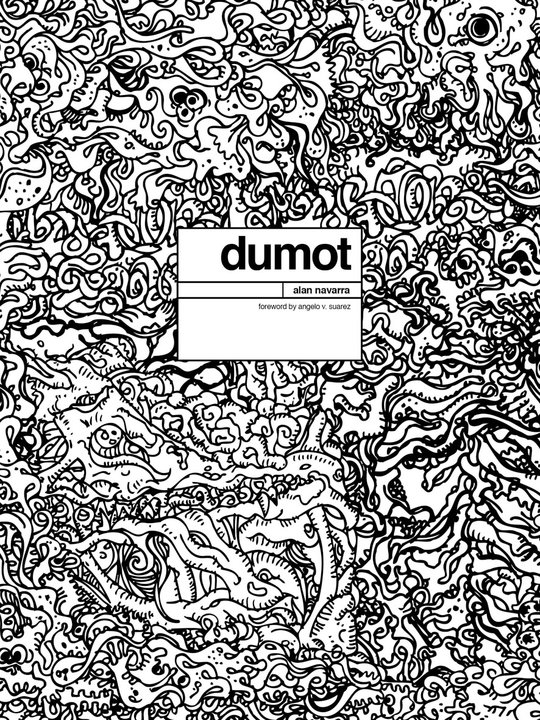
Book Review: dumot by Allan Navarra

WARNING: Explicit Language
Dumot is a book that illustrates fragments of a man’s aggression: his inner demons, his state of mind and physical being as he deals with the rigors of working in a challenging atmosphere. The title is a Hiligaynon word that, in English means “ vindictiveness”. Dumot is also composed of two French words (du and mot ) which mean “the word”, making it sound all hoity-toity. Almost half of the book is illustrated, which is great for people who can't read but have the time to flip pieces of paper with drawings on them, back and forth. Allan Navarra

Monday, September 12, 2011

Vizprint WIT Reader's Day Review

I was supposed to participate in a tree-planting event by the Luzon State jurisdiction at the La Mesa Reservoir in Fairview last Saturday when my alarm clock failed to fulfill its purpose of waking me at 4 in the morning. I was devastated that I was left by my brothers. Fortunately on a different account, I had read the day before in Will's blog an event where I could meet the authors of my fave pop comics and literature. So goes the spontaneous change of plans for the day for failing to wake up early.

Photos from the exhibit hall of the recent Visprint Writers in Talk first ever annual reader's day held at the SMX Convention Center in the Mall of Asia Compound last Saturday (Credit goes to Ate Mylene Reyes for lending me permission to use flicks of the event)

 
Was hyped to see them in flesh: Paolo Fabregas (The Filipino Heroes League), 
Manix Abrera (Kikomachine Komix Collection), Karen Francisco (Naermyth), 
Carlo Vergara (Zsa Zsa Zaturnah) and Alan Navarra!

My starstruck moment with Alan Navarra, author of Girl Trouble (2007) and the recently released dumot. Apparently, the latter title has not been released in the market yet. The first printed copies were introduced during the event. I had mine signed. And I think I'm the first reader to have ever laid an eye in these babies :) ayeee~!

Monday, August 15, 2011

Update 8.15.11: Bed-side Books

My free time have awarded me with a chance to catch up with some of my reading backlogs. There are at least six bed-side books that I've been reading alternately lately, most of them are catholic reads. By far, I've been enjoying quite a lot the book 'In Pursuit of Love: Catholic Morality and Human Sexuality' by a Jesuit priest, Vincent Genovesi that discusses a handful of hot-topic issues - premarital sex, contraception and marital sexuality, homogenital expressions of love, masturbation and abortion - from a philosophical and theological stand. Challenging, sometimes I'm even forced to read a paragraph twice or thrice to digest and understand. Then even sometimes followed by a momentous stop of pondering. Truly is the joy of reading a book on Christian Ethics for the first time :) 

Sinong nakaka-relate sa mga binabasa kong book? Raise your hand!
To love at all is to be vulnerable. Love anything and your heart will certainly be wrung and possibly be broken. If you want to make sure of keeping it intact, you must give your heart to no one, not even to an animal. Wrap it carefully around with hobbies and little luxuries; avoid all entanglements; lock it up safe in the casket or coffin of your selfishness. But in that casket - dark, motionless, airless – it will change. It will not be broken; it will become unbreakable, impenetrable, irredeemable. The alternative to tragedy, or at least to the risk of tragedy, is damnation. The only place outside Heaven where you can be perfectly safe from all the dangers and perturbations of love is Hell.
'The Four Loves' (New York: Harcourt Brace Jovanovich, 1960)
As quoted from ‘In Pursuit of Love: Catholic Morality and Human Sexuality, 2nd edition’ by Vincent J. Genovesi, SJ

Thursday, March 26, 2009

Book Review: Real Boys' Voices


I’m currently reading a book by Dr. William Pollack, Ph. D., entitled Real Boys’ Voices that I recently bought for only P50 in a super summer sale of a favorite bookstore.

In this book, he explored the profound, painful issues that most teenage boys face on today’s generation. We hear from boys and young men in big cities and small towns in America who share compelling, extraordinarily candid stories about the issues and dilemmas they face everyday ranging from drugs, sex, violence, bullying, sports, girls, parents and so much more.

He discussed about the subconscious Boy Code that society and the media have implanted in the minds of these growing young boys, the mask of masculinity and the gender straightjacket – old rules that favor male stoicism driving them to feel ashamed about expressing weakness and vulnerability in the fear that they will be teased, bullied, humiliated, and beaten up, by other boys if they give voice to their truest feelings.

It’s an eye-opening book, personally. I can’t believe I was not alone all along and that somewhere in the other side of the globe, boys my age are also undergoing the same kind of struggles in their lives.

I may be an upcoming third year college student but you can’t rid of the fact that I’m only 17 and most of the issues discussed in this book perfectly matched what I’ve been through so far. Maybe my personals issues have been resolved but as I devour the pages of that book, I was reminded of all the hurt.

I remember the pain and fear of being called feminine, even though I clearly know inside that I’m not. I remember all the name-calling, being bullied and harassed by other kids when I was only five; the sting of great loneliness and despair when I got no one to talk to about my deepest concerns; the rage and anger that boils up inside me about stereotyping; the pressure to have a girlfriend, to be independent, to take it all in and bottle it all up.

I still remember everything that has caused me great insecurities, the foundation of my low self-esteem, and the root of all my fears. And now I fully understand better why and how I become a victim of society’s expectations.